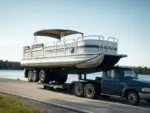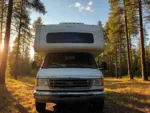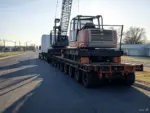

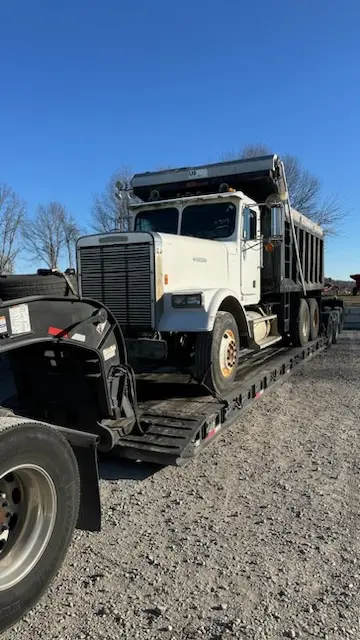
If your truck, motorhome, or other self-propelled unit already runs and is street-legal, you do not always need to crane it onto a flatbed. Sometimes the smartest move is simpler: we send a professional driver, they get behind the wheel of your vehicle, and they drive it to the destination.
That is driveaway transport.
This Guide explains what driveaway trucking actually is, how it differs from power only and open-deck hauling, when the federal “driveaway-towaway” rules show up, and what specs Logi Transports needs so your quote is real — not a teaser that dies at the first red light.
Need a ferry driver for your unit? Call (864) 791-5644 or use the quote request form.
What is driveaway transport?
Driveaway transport (also called driveaway trucking, ferry driving, or a driveaway move) is an arrangement where the carrier supplies the driver, and you supply the vehicle. The driver arrives at pickup, inspects the unit for roadworthiness, then drives it under its own power to delivery. There is no second trailer under the cargo — the cargo is the vehicle on the road.
At Logi Transports, that model is how we move a lot of real-world iron that already has a license plate (or should):
- Day cabs, sleepers, and vocational trucks that need repositioning
- Motorhomes and RVs that are safer and cheaper to drive than to load on a deck
- Roadworthy heavy trucks that would be cost-prohibitive to permit as oversize freight on an RGN
- A truck-and-trailer combo when both the power unit and the trailer need to move together (the driver tows your trailer with your truck)
See our service page for driveaway transport services for how we staff these moves.
Driveaway vs power only vs loading on a trailer
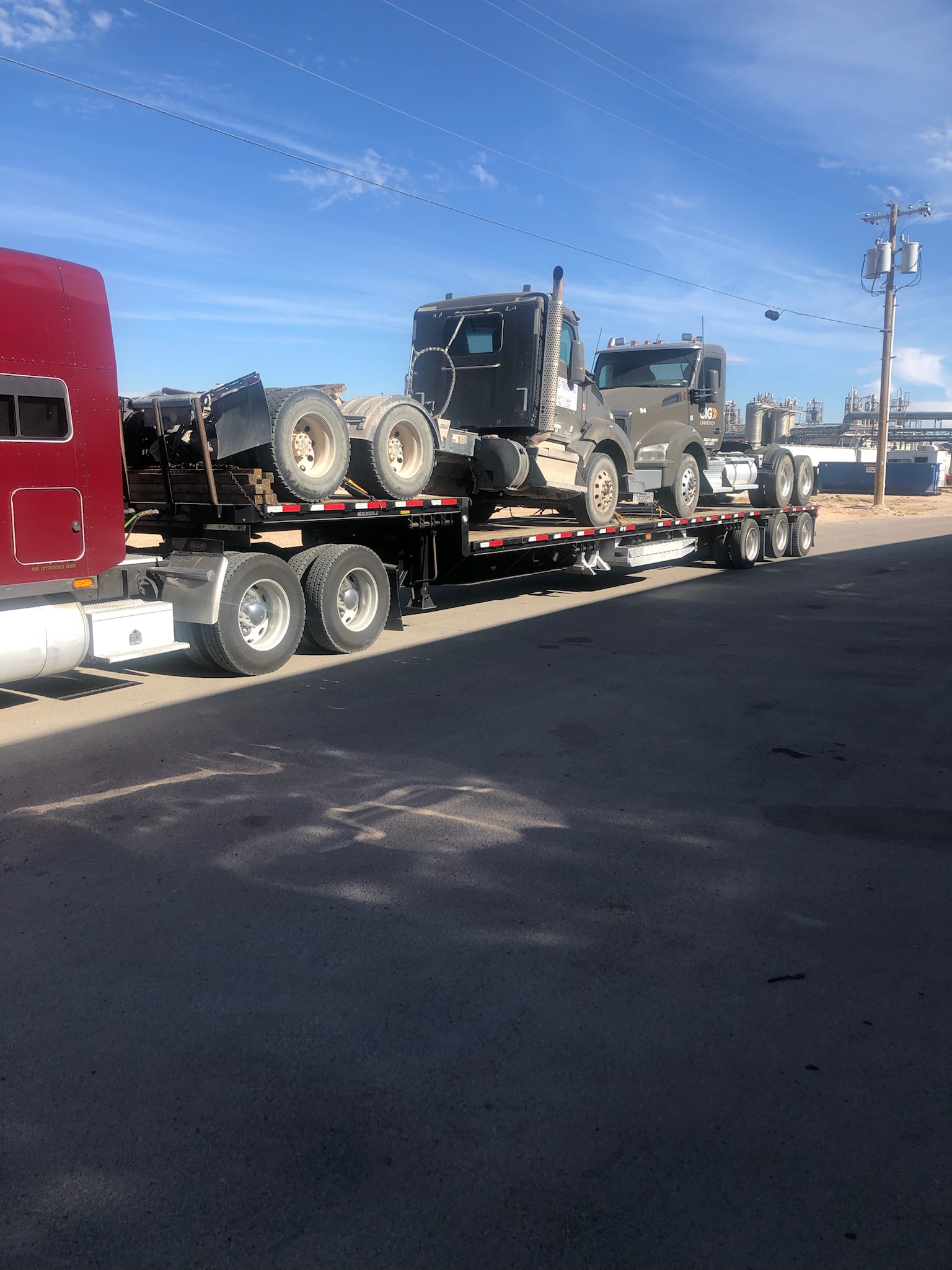
People mix these three up because all of them can involve a semi or a long highway day. The difference is what sits under the cargo — and whether the cargo drives itself.
| Option | What we bring | What you provide | Best when… |
|---|---|---|---|
| Driveaway | Driver only (ferry driver) | A self-propelled, roadworthy vehicle | The unit drives itself legally |
| Power only | Tractor + driver | Your trailer (already roadworthy) | The unit is already on a legal, towable trailer |
| Flatbed / step deck / RGN haul | Tractor and open-deck trailer | The machine or cargo only | No driveable/towable setup, or the unit must ride on a deck |
If your excavator is sitting on the dirt with no trailer and does not drive on the highway, you need an open deck — usually flatbed, step deck, or RGN. That is the world covered in our RGN vs step deck vs flatbed Guide and our 2026 heavy equipment transport cost ranges.
If you already own the trailer and just need a tractor to pull it, that is power only transport — not driveaway.
If the unit starts, steers, brakes, and is legal to operate on public roads, driveaway is often the cheapest and simplest path: no crane, no second deck height stack, no loading day.
The federal “driveaway-towaway” definition (and why it matters)
In everyday freight talk, “driveaway” means a ferry driver in your vehicle. In federal safety rules, driveaway-towaway operation is a defined term.
Under 49 CFR 390.5, a driveaway-towaway operation is an operation in which an empty or unladen motor vehicle with one or more sets of wheels on the roadway is being transported — for example between a manufacturer and a dealership or purchaser, between a seller/lessor and a purchaser/lessee, to a terminal or shop for crash or mechanical repairs, or by means of a saddle-mount or tow-bar.
That regulatory bucket covers factory-to-dealer deliveries, multi-unit tow-bar / saddle-mount combinations, and repair-facility ferry moves. Your retail RV or single truck ferry is still commercial for-hire transportation when we arrange it — the carrier still needs proper authority and insurance — but the paperwork stack and inspection carve-outs can differ from a loaded flatbed haul.
Inspection rules for combinations show up in 49 CFR 396.15: before a driveaway-towaway combination departs, the motor carrier must carefully inspect and test that tow-bar or saddle-mount connections are properly secured, function without cramping or binding, and that the towed vehicle follows substantially in the path of the towing vehicle without whipping or swerving. After the trip, tow-bars and saddle-mounts must be disassembled and inspected before reuse.
Practical takeaway for you: if we are ferrying one roadworthy truck or motorhome under its own power, expect a serious pre-trip walkaround. If the move involves towing another vehicle (tow-bar / saddle-mount style), expect the combination rules above — not a casual hitch-and-hope.
Size and weight still matter when the cargo drives
Putting a driver in the seat does not invent a new size-and-weight universe. The vehicle (or combination) still has to live inside federal and state limits — or you buy permits / choose a different product.
Per the FHWA commercial vehicle size and weight program, Interstate maximums include:
- 80,000 pounds gross vehicle weight
- 20,000 pounds on a single axle
- 34,000 pounds on a tandem
- 102 inches of width on the National Network
There is no federal height limit. FHWA notes that state standards generally range from 13.6 to 14.6 feet. Florida (our home base in Sebastian) is commonly a 13 feet 6 inches legal height state.
So a tall motorhome, a vocational truck with a high body, or a truck pulling a tall fifth wheel can still push a “simple drive” into oversize load transport territory — or make an open-deck RGN the smarter (and sometimes cheaper) call once permits and escorts stack up.
When driveaway is the right call
Choose a ferry driver when most of these are true:
- The unit is self-propelled and designed to operate on public roads
- It is roadworthy: tires, brakes, lights, steering, registration, and insurance are in order
- Loading onto a second deck would cost more than the drive (crane, yard time, height permits)
- You want the odometer miles and a human who can catch a mechanical issue early — not a winched-on surprise at delivery
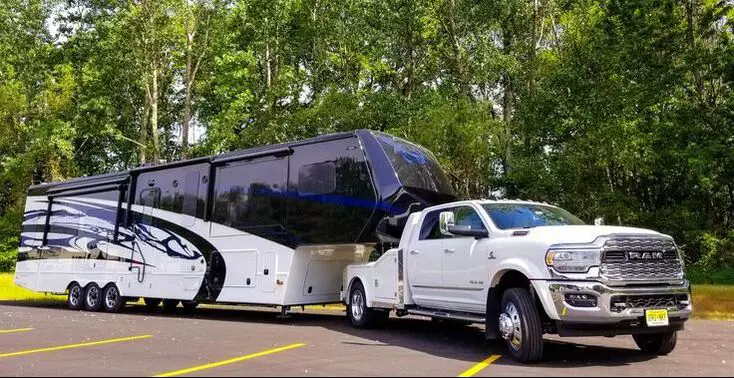
- You are moving a truck that will also tow your trailer (fifth wheel, bumper pull, gooseneck) in one coordinated move
Classic Logi use cases:
- Truck repositioning — empty day cab or sleeper needs to be in another state next week
- Motorhome / RV ferry — often cheaper and gentler than deck loading a tall coach
- Truck + trailer combo — driver ferries your truck and pulls your fifth wheel or travel trailer; prep the trailer with our fifth wheel prep checklist
- Units too tall or awkward to deck economically — when RGN + permits would dwarf a legal drive
When driveaway is the wrong call
Do not force a ferry when:
- The machine is non-running, seized, or unsafe to operate — you need a deck (and often a winch or crane)
- Registration, plates, or insurance are not sorted — a driver cannot legally “just go”
- The unit is equipment that never belonged on the highway (excavator on tracks, dozer, skid steer) — that is flatbed / step deck / RGN territory, including excavator transport and skid steer transport
- You only have a trailer and no roadworthy power unit — that is power only, not driveaway
- Height, width, or weight of the driven combination forces a permit nightmare that a lower RGN haul would avoid
You the client are our top priority here at Logi Transports — we would rather talk you into an RGN you need than sell you a driveaway that gets parked at the first weigh station.
What we need for a tight driveaway quote
Send this and we can tell you if a ferry is legal, permitted, or the wrong tool:
- Exact unit type — year, make, model (truck, motorhome, vocational, etc.)
- Whether it runs and drives in current condition (honest answer — soft brakes kill timelines)
- Plate / registration / insurance status for the route states
- Travel height / width / length and approximate GVWR if known (especially for tall coaches and body trucks)
- Whether a trailer comes too — hitch type, brake system, and trailer dimensions
- Full pickup and delivery addresses, gates, and whether the driver can get in and out
- Date flexibility (ferry drivers often reposition by air/Uber/rail to the pickup)
Ask for all-in pricing: driver fee, travel to pickup, fuel policy, tolls, and any permits if the combination is oversize. A cheap base drive with add-ons billed later is how a simple relocation gets expensive.
CEO Benjamin C. Hall and the team built Logi to stop the avoidable messes — wrong product assumption, non-running unit, nobody answering when the driver is two hours out. Read more on Why Logi.
Get your driveaway transport quote
Ready to put a professional in the seat of the vehicle you already own? Call (864) 791-5644, email quotes@logitransports.com, or submit the quote request form with year/make/model and whether it runs. We will come back with a clear plan: driveaway ferry, power only pull, or an open-deck haul if that is what the iron actually needs.
We will take it from there.