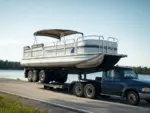

You found the right pontoon at a dealer two states away, you are moving to a lake house, or you are heading south for the winter and want the boat waiting for you. Learning how to ship a pontoon boat is mostly about three things: picking the right hauling method, knowing your real dimensions, and prepping the boat so the logs, fence, and motor arrive the way they left. Pontoons ride and tie down differently from V-hull boats, so a little planning saves you damage, delays, and surprise fees.
Want a price now? Call (864) 791-5644, email quotes@logitransports.com, or fill out our quote request form. Give us the year, make, model, length, and whether the boat is on its own trailer, and Logi Transports will match it with the right carrier.
Three ways to ship a pontoon boat
Most pontoon moves fall into one of three setups. The right one depends on whether you have a roadworthy trailer, how many boats are moving, and how far they are going.
| Method | How it works | Best for | Watch out for |
|---|---|---|---|
| On your own trailer (power-only) | A truck hooks up to your boat trailer and pulls it to the destination. | Single boats on a sound, registered trailer; dealer-to-owner moves | Tires, bearings, lights, and brakes must be road ready; the trailer has to come back or stay at delivery |
| On a carrier’s boat hauler | The boat is loaded onto a hydraulic or bunk-style hauler owned by the carrier. | Boats with no trailer or a trailer that is not safe for a long run | Pickup and drop-off need a ramp, lift, forklift, or crane, depending on the setup |
| Flatbed or step deck | The boat sits on cradles or its trailer on the deck and is strapped down. | Multiple boats, dealer stock, or boats moving with other freight | Total height once loaded; straps must sit on the frame and logs, not the fence |
If your boat already lives on a good trailer, power-only is often the simplest move. Our Guide on what power-only transport is explains how it works. For deck loads, see RGN vs step deck vs flatbed to understand why a lower deck can matter for tall boats.

Know your pontoon’s real dimensions
Brochure length is not the number a carrier needs. Pontoon makers publish several measurements, and they are often very different. The SUN TRACKER spec sheet for the 2026 Party Barge 24 XP3 lists an overall length of 26 ft 2 in, but a towing and storage length of 37 ft 9 in. It also lists a package width of 8 ft 6 in, a package height of 8 ft 10 in, an average dry weight of 3,360 lb, and an average package weight of 5,685 lb.
Those gaps are why quotes go wrong. Give your carrier the towing length (boat plus trailer and tongue), the widest point (deck, rub rail, or anything that hangs off the side), and the package weight with the motor, not just the hull.
Measurements to send with your quote request
- Towing length: tip of the trailer tongue to the back of the motor in its trailering position.
- Width: the widest point, measured across the deck, fence, or side-mounted gear.
- Height: the highest point with the bimini and any tower folded down. If the boat will ride on a deck, the deck height adds to this.
- Weight: boat, motor, and trailer. Use the manufacturer’s package weight if you do not have a scale ticket.
- Logs: two logs or three (tritoon), since that changes how the boat sits on cradles and bunks.
Width and height: why 8 ft 6 in matters
Federal rules set the standard commercial vehicle width at 102 inches on the National Network. According to FHWA, the Surface Transportation Assistance Act of 1982 extended the 102-inch width to commercial trucks. That is exactly 8 ft 6 in, which is the same deck width many popular pontoons are built to.
Height works differently. FHWA notes there is no federal height limit for commercial vehicles. States set their own, and most range from 13 ft 6 in to 14 ft. A boat that sits low on its own trailer usually has plenty of room. Put a tall boat with an arch or a fixed tower on a flatbed deck, and the total climbs fast. If your pontoon is wider than 8 ft 6 in or ends up over the state height limit once loaded, it becomes an oversize load. Logi handles that through our oversize load transport service.
How to prep a pontoon boat for shipping
Pontoons have more exposed parts than most boats: fence panels, bimini frames, furniture, and a big outboard hanging off the back. Our general boat transport prep Guide covers the basics. These steps are specific to pontoons.
Pontoon shipping checklist
- Bimini top: fold it down, put on the boot, and strap the frame so it cannot bounce. Take the canvas off if it might flap.
- Cover: use a cover built for road travel, or none at all. A loose mooring cover can shred and scuff the fence at highway speed.
- Loose gear: take out cushions that are not fastened, the table, life jackets, coolers, anchors, ladders, and electronics. Lock storage lids.
- Gates: latch and tie every gate so it cannot swing open.
- Motor: tilt it to trailering position and support it the way the motor maker recommends so the transom is not taking every bump.
- Fuel and battery: run the tank low and turn off the battery switch or disconnect the battery.
- Drain: empty the bilge, livewell, and any water lines, especially in cold weather.
- Photos: take date-stamped photos of every log, the fence, the deck, and the motor before pickup.

If it rides on your trailer, check the trailer first
With power-only, your trailer is part of the shipment. A failed bearing or a flat tire is the most common reason a pontoon move stalls on the shoulder. Before pickup, check tire age and pressure, wheel bearings, lights and wiring, the coupler and safety chains, and the brakes if the trailer has them. Make sure the bunks are in good shape and the boat sits centered on them. Tell us about any issue up front so we can plan around it. Our power-only trailer page has more on how we move customer-owned trailers.
Tie-down points: logs and frame, not the fence
Fence panels and rails are built to keep people on board, not to hold a boat on a trailer. Straps should go over the logs or attach to the trailer and frame at solid points. A good carrier will use padding where straps touch aluminum and recheck tension after the first miles. If you have a tritoon, ask how the center log will be supported so the weight is spread evenly.
Pickup and delivery: plan the loading point
If the boat stays on its trailer, pickup is as simple as a hookup. If it has to come off the water or move onto a carrier’s hauler or a flatbed, someone needs a way to load it: a ramp, a marina lift, a forklift rated for the weight, or a crane. Confirm the marina’s hours and fees ahead of time and tell us if the drive is tight, gated, or soft ground. Lake houses with narrow roads and steep driveways often need a smaller truck or a meeting point.
What affects the cost to ship a pontoon
- Distance and route, including tolls and rural pickups
- Method: power-only on your trailer is usually simpler than a deck load
- Size: towing length, width, and height, and whether permits are needed
- Season: spring and the fall snowbird run get busy, so book early
- Loading: whether a lift, crane, or forklift is needed at either end
- Timing: flexible pickup windows usually price better than a fixed date
For more on our boat services nationwide, see pontoon boat transport and boat transport near me.
Why ship your pontoon with Logi Transports
As a licensed broker, Logi Transports finds the carrier, checks their authority and insurance, and matches the right truck and trailer to your boat. You get one point of contact from quote to delivery instead of calling a dozen outfits and hoping one shows up.
Get a pontoon boat shipping quote from Logi
Logi Transports is a Sebastian, Florida freight broker (MC-1636889, USDOT 4230991). We arrange power-only, boat hauler, and flatbed transport for pontoons and tritoons nationwide. To get an accurate quote, send the year, make, and model, towing length, width and height, weight, whether it is on its own trailer, and the pickup and delivery city and state.
Call (864) 791-5644, email quotes@logitransports.com, or fill out our quote request form. Tell us you need to ship a pontoon boat, and we will recommend the method that fits your boat, your schedule, and your budget.