
If you just won a machine at auction, or you need a dozer on a job next week, the first question is always the same: how much is this going to cost to move?
There is no single 2026 tariff for heavy equipment. A compact skid steer on a hotshot is a different job than a permitted excavator on an RGN trailer. The number you get back depends on miles, weight, dimensions, trailer type, permits, escorts, season, and how hard the sites are to get in and out of.
You the client are our top priority here at Logi Transports. We would rather walk you through a real range than sell you a teaser rate that blows up once the permits hit. Below is how heavy equipment transport cost actually works in 2026 — industry planning ranges, not a guaranteed bid — plus the federal and state rules underneath them.
Need a number for your machine? Call (864) 791-5644 or use the quote request form.
Typical 2026 cost ranges (planning numbers, not a bid)
Federal law does not set your freight rate. What it does set is the legal Interstate envelope. The FHWA commercial vehicle size and weight program puts Interstate maximums at 80,000 pounds gross vehicle weight, 20,000 pounds on a single axle, 34,000 pounds on a tandem, and 102 inches of width. Height is a state call — FHWA notes state standards generally run 13.6 to 14.6 feet. Anything outside that envelope becomes a permitted load, and that is where money starts stacking.
Industry haul guides published in 2026 put current heavy haul shipping rates in the ballparks below. Treat them as ranges that move with distance, weight, permits, and escorts.
| Load / trailer type | Typical 2026 planning range | What that usually covers |
|---|---|---|
| Legal-size lowboy / RGN | About $3.50–$8.00 per loaded mile | A machine that stays inside legal size and weight |
| Oversize or overweight (all-in) | About $5.00–$15.00+ per mile | Linehaul plus permits, escorts, and fuel on many quotes |
| Standard flatbed freight | About $2.10–$3.50 per mile | Mid-weight, legal-dimension equipment |
| Step deck | About $3.00–$3.50 per mile | Taller machines that need extra height clearance |
| Hotshot (compact units) | About $1.50–$2.50 per mile | Lighter legal loads such as a small skid steer |
| Local legal move (under ~100 miles) | About $300–$800 flat | Dispatch minimums — not a cheap per-mile job |
| Local oversize move (under ~100 miles) | About $800–$2,500+ flat | Short permitted run with extra setup |
Those per-mile bands come from 2026 industry guides, not from FMCSA or any DOT tariff. O Trucking’s lowboy rate guide (updated September 1, 2026) is the most detailed public breakdown we found: legal lowboy $3.50–$8.00/mile, oversize/overweight all-in $5.00–$15.00+/mile, local legal $300–$800, local oversize $800–$2,500+, and a 500-mile legal example of roughly $1,750–$4,000. Other 2026 haul guides (Rossini Equipment, Elevation Transport Services) published matching trailer-type bands. Every job is still quoted on its own facts.
Heavy Haul Experts (February 2026) illustrated a 30,000 lb excavator going 500 miles on a lowboy around $2,000–$3,000. Superloads are custom, with published examples starting around $10,000–$15,000 and running much higher. Those are examples, not your invoice.
What actually drives the quote
If two quotes are $2,000 apart, it is rarely because one broker “likes you more.” It is because they assumed a different trailer, a different permit stack, or a different amount of pain at the jobsite.
Miles — and why a short haul can cost more per mile
More miles usually mean a bigger total. Per-mile, the opposite often happens. Loading, deadhead to the pickup, and permit paperwork are mostly fixed. Spread those over 80 miles and the rate looks expensive. Spread them over 800 miles and it looks cheaper. That is why local work is so often a flat minimum.
Rural pickups, mountain routes, and lanes with no backhaul pay more. The truck still has to get home.
Weight, dimensions, and permitted loads
Give us the operating weight, not the brochure. Attachments, buckets, extra counterweight, and a full tank all count. Width, height, and length in travel position decide whether you are legal or you are buying oversize load transport.
Once you are over the federal or state envelope, you are in permitted loads territory. FHWA is blunt: the federal government does not issue oversize or overweight permits. Each state does. A five-state run is five permit offices, five rulebooks, and sometimes five different escort triggers.
From Florida (we sit in Sebastian), you need an overweight/oversize permit if width exceeds 102 inches, height exceeds 13 feet 6 inches, or gross weight exceeds the legal limits in Florida Statute 316.535. A Florida trip permit covers one origin-to-destination move and is good for ten days. FDOT’s Over-Weight Over-Dimension office issues those permits for state-maintained roads.
If the machine is heading through Texas, TxDMV requires an OS/OW permit and wants exact dimensions and weight up front. Our Texas heavy equipment transport page covers the rest: legal height 14 feet, width 8 feet 6 inches, gross 80,000 pounds, plus escort and superheavy rules.
Industry guides put a typical single-state oversize permit around $15–$200, overweight $50–$500+, and superload permits much higher. Pilot cars are commonly $500–$1,500 per vehicle per day. Your corridor will differ.
RGN trailer vs step deck vs flatbed freight
Trailer choice is half the quote.
- Flatbed freight is the workhorse when the machine is legal height and you can load from the side or with a forklift.
- A step deck drops the main deck so a taller cab or boom stays under the bridges. You often avoid a height permit that a standard flatbed would trigger.
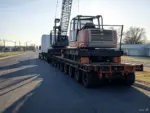
- An RGN trailer (removable gooseneck, a type of lowboy) detaches at the front so the machine can drive or be winched on from ground level. That is the usual answer for a mid-to-large excavator, dozer, or anything you would rather not crane-load.
Specialized iron costs more to own, insure, and dispatch than a regular flatbed. That is why legal lowboy sits above flatbed in the table, and why oversize RGN sits above that.
Season, access, and load/unload
Construction season is equipment season. One 2026 haul guide treats March through May as the expensive window and winter as the softer one, citing a rough 15–25% swing. If your calendar is flexible, December through February is usually when carriers have more open decks.
Access matters as much as the highway. A paved dealer yard is easy. A muddy pad with a low tree limb is not. Non-running equipment can mean a winch or a crane — crane-assist examples run $500–$3,000+ per end, billed separately. Multi-state also means daylight-only rules, holiday blackouts, and city curfews. The truck can be ready and still sit until the permit allows movement.
How much to ship an excavator (and a skid steer)
How much to ship an excavator is the search we see the most, so let’s be direct.
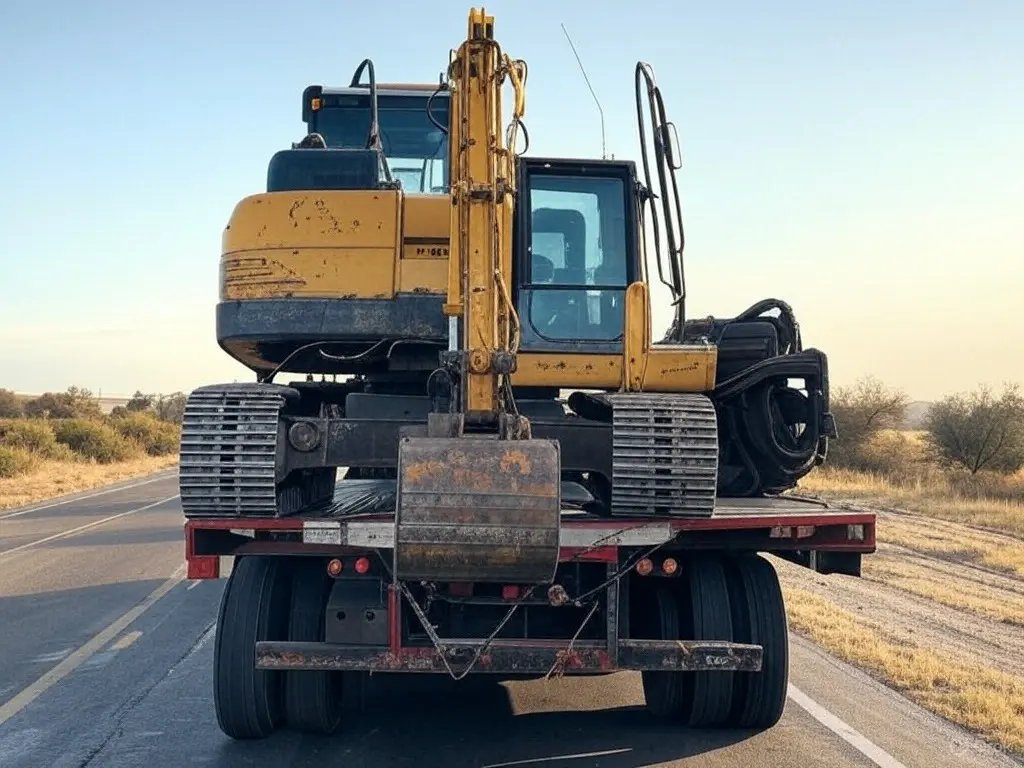
A compact excavator that stays legal on a step deck or hotshot can live in the lower end of the table. A mid-size or large machine usually wants a lowboy or RGN, and many of those trips are permitted for width, height, or both. That is why excavator transport is its own service.
Using published 2026 examples (examples, not bids):
- ~30,000 lb excavator, about 500 miles, lowboy: illustrated around $2,000–$3,000 (Heavy Haul Experts, 2026)
- Same distance, oversize/overweight with permits and a pilot car: plan off the $5–$15+ all-in per-mile band
- Skid steer or compact loader, legal size: often hotshot or flatbed, which is why those numbers sit under lowboy
If you bought the machine at Ritchie Bros. or another auction, budget transport before you bid. Ritchie Bros.’ shipping guide is clear: cost depends on distance, size, weight, trailer type, permits, escorts, and season, and the buyer usually arranges the truck. Call us with the lot number, make/model, and both addresses.
How to get a quote that does not change at the scale
We can only price what we can see. The fastest way to a tight number is:
- Year, make, model, and whether it runs.
- Operating weight and travel length / width / height, including the bucket, blade, or boom. If you are not sure how to take overall dimensions, our how to measure a semi truck guide is the same idea: measure the widest and highest points, then write them down.
- Full pickup and delivery addresses, not just cities. Tell us about dirt vs. pavement, gates, overhead wires, and whether a trailer can get in and out.
- Date flexibility. “Anytime next week” almost always beats “has to load tomorrow at 6 a.m.”
- Ask for all-in pricing: linehaul, fuel, permits, and escorts. A cheap base rate with permits billed later is how a $4,000 move becomes $7,000.
That last point is not a scare tactic. O Trucking’s 2026 worked example is a 60,000-pound excavator going 800 miles across four states: $4,000 base transport, then about $800 in overweight permits, $2,000 for a two-day pilot car, and $400 in permit service fees — $7,200 all-in. Ask for the full stack up front.
The cheapest quote is often the most expensive one
Heavy haul is not dry-van freight. The carrier needs the right trailer, active authority, and a permit plan that will survive the first weigh station. FMCSA safety rules apply to interstate commercial motor vehicles at 10,001 pounds GVWR and up; size-and-weight limits live with FHWA and the states. Cutting those corners does not save you money. It parks your machine on the shoulder.
Why Logi? We started this company to stop the avoidable messes — wrong trailer, missing permit, nobody answering the phone when the driver is two hours out. Benjamin C. Hall and the team will tell you if a step deck is enough, or if you really need an RGN. You the client are our top priority.
Logi Transports is a Sebastian, Florida freight broker (MC-1636889, USDOT 4230991). We arrange oversize and legal heavy equipment moves in all 50 states.
Get your 2026 heavy equipment transport quote
Ready to move it? Give us the specs and we will come back with a real plan — trailer type, permitted or legal, and an all-in number you can take to your job cost sheet.
Call (864) 791-5644
Email quotes@logitransports.com
Or send the details through our quote request page.
We will take it from there.