
You found the right combine two states away. Maybe it was a Deere S-Series off a dealer lot, a Case IH Axial-Flow at a farm retirement auction, or a used Gleaner or New Holland that finally fit the budget. Harvest does not wait, so the next question comes fast: how to transport a combine without paying for the wrong trailer, getting turned away at the scale, or watching a driver refuse the load because the header, duals, and grain tank extensions were never part of the quote.
A combine is not a tractor with a bigger cab. You are really shipping two pieces of equipment (the machine and its header), and the base unit by itself is wide, tall, and top-heavy. This Guide covers how to split the load, the legal size envelope, how to measure in travel position, which deck fits, a prep checklist built around 49 CFR 393.130, farm and auction site access, and exactly what to send for a real quote. It builds on our farm equipment transport service and our how to transport a farm tractor Guide, with the details that only matter for combines.
Need a deck for your combine? Call (864) 791-5644, email quotes@logitransports.com, or use the quote request form.
Why combines are their own kind of haul
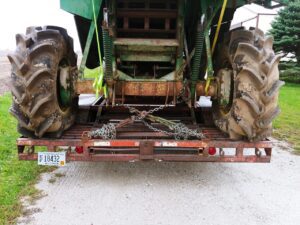
Three things make a combine harder to move than most farm iron. First is the header. Corn heads, rigid platforms, flex platforms, and drapers almost never ride on the combine. They are wider than any legal trailer and usually go on a header transport cart or a second flatbed. Second is width at the axle. Dual front tires, wide flotation tires, or tracks can put the bare machine over the 102-inch line before anything else is counted. Third is height. The cab, grain tank extensions, unloading auger, and beacon lights stack up quickly once the machine is sitting on a deck.
That is why Logi starts with the travel dimensions of the base unit, what happens to the header, and whether the machine runs and can drive onto the deck. Then we match a step deck, RGN, or flatbed, not the other way around. For budget ranges (not a bid), see our 2026 heavy equipment transport cost Guide.
The legal envelope (FHWA, state height, and the farm exemption)
Federal rules do not choose your trailer. They set the size and weight envelope on the Interstate and the National Network. Your loaded truck has to fit inside it, or you buy permits. According to the FHWA size and weight program and 23 CFR 658.17, the Interstate limits include:
- 80,000 pounds gross vehicle weight
- 20,000 pounds on a single axle
- 34,000 pounds on a tandem
- 102 inches of width on the National Network
There is no federal height limit. FHWA notes state limits generally run from about 13.6 to 14.6 feet. In Florida, where Logi is based, legal height is 13 feet 6 inches including the load, and width is generally 102 inches, under Florida Statute 316.515.
Here is the part that trips people up. That same Florida statute lets farm equipment exceed width and height without a permit when it is temporarily operated in daylight on roads that are not limited-access highways, within 50 miles of land the owner farms (dealer deliveries to a buyer are not held to the 50 miles). Equipment wider than 174 inches also needs side warning lamps and a slow-moving vehicle sign. That covers a farmer or dealer moving a machine down a county road. It does not cover a long-distance truck haul on the Interstate. Once your combine is going across the state or across the country, plan for normal legal limits or oversize load transport with permits. Every state runs its own permit office, and FHWA keeps a state permit overview.
Split the load: base unit, header, and cart
Almost every combine move is planned as at least two pieces:
- Base unit: the combine itself, with the feeder house raised and the header removed.
- Header: the corn head or platform, usually strapped to its own header transport cart or loaded flat on a flatbed or step deck. Wide platforms may need their own permit even when the combine does not.
- Extras: the header cart (if it is not carrying the header), removed duals, a straw chopper or spreader taken off for height or length, and any spare parts the seller is including.
Tell us up front whether the header travels with the combine, on its own trailer, or not at all. That one answer changes the truck count, the permits, and the price more than anything else on the quote.
Measure the combine in travel position
Brochure specs are measured for the field, not for a trailer. Measure the machine the way it will actually sit on the deck:
- Weight: the base unit with the grain tank empty, plus the header’s weight on its own. This sets axle loading against the 80,000-pound federal limit.
- Height: the highest point with grain tank extensions folded, the unloading auger stowed, and beacons or antennas removed or folded. Add the deck height to get your loaded height.
- Width: the widest point across the tires or tracks, mirrors, and steps. Measure with and without duals if you are willing to remove them.
- Length: from the front of the feeder house to the back of the spreader or chopper, with the unloading auger folded in.
- Header: the header’s width, depth, and weight, and whether it comes with a cart.
Add the year, make, model, and serial number. Auction yards and dealers use them to release the right machine. The same discipline appears in our how to prepare heavy equipment for transport checklist. For combines, the extra steps are about the header, the duals, and the grain tank.
Which deck: step deck, RGN, or flatbed?
The deck heights below are typical industry planning figures, not federal standards. Trailers vary by manufacturer and axle setup, so always measure and confirm with the carrier. The full comparison is in RGN vs step deck vs flatbed.
| Trailer | Typical deck height | Best for combines when… |
|---|---|---|
| Flatbed | About 48–60 inches | Headers, header carts, and removed parts. It is rarely the right deck for a modern base unit because of height. |
| Step deck | Lower deck about 36–42 inches | Older or smaller combines whose folded height stays under the state limit, with ramps or a loading dock available |
| RGN / lowboy | Well about 18–24 inches | Most mid-size and large combines. The low deck buys height clearance, and the removable gooseneck lets a running combine drive straight on. |
| Multi-axle RGN | Similar well height | Heavy, wide, or tracked machines that need permits and extra axles to spread the weight |
If the combine is still over width on an RGN after you pull the duals, you are into a permitted load, and escorts may be needed depending on the states on the route. We handle that as part of the move. You do not have to call each state yourself.
Prep checklist and cargo securement (49 CFR 393.130)
Under 49 CFR 393.130, heavy wheeled or tracked equipment weighing 10,000 pounds or more must have its accessory equipment completely lowered and secured. The machine also has to be restrained against movement in every direction with at least four tiedowns at the front and rear or at the manufacturer’s tie points. A combine is well past that weight, so plan for it.
- Grain tank: Run it empty and clean out leftover grain. Grain is extra weight and can shift.
- Header and feeder house: Remove the header and lower or lock the feeder house per the operator’s manual so nothing can drop in transit.
- Unloading auger and extensions: Fold the auger into its cradle and fold down the grain tank extensions. Strap them if your manual says to.
- Duals and wide tires: Decide before the quote whether the duals come off. Removing them is often the difference between a legal load and a permitted one.
- Loose parts: Take off or secure chopper knives, spreader parts, ladders, mirrors, and GPS receivers that could shake loose or set the height.
- Fluids and leaks: Fix active leaks. Keep fuel low but enough to drive on and off. Follow the manual’s transport section for parking brakes and battery disconnects.
- Photos: Shoot all four sides plus close-ups of glass, the feeder house, the auger, the tires or tracks, and the serial plate. Repeat the same photos at delivery before you sign.
- Running or not: Put it in writing. A running combine can usually drive onto an RGN. A dead one needs a winch, which changes the truck and the price.
Site access: farms, dealers, and auctions
A perfect prep job still fails if the truck cannot reach the combine. Before pickup and delivery, check these:
- Field gates and lane width. An RGN and tractor need much more room to turn than a pickup.
- Power lines, trees, and bin-site wires along the driveway. Height still matters on the way out of the yard.
- Firm, dry ground. A wet field or soft lane will stop a loaded lowboy, so stage on gravel or pavement when you can.
- Room to drop the RGN’s gooseneck without blocking the road.
- Auction rules. Per Ritchie Bros. loadout policies, the buyer arranges loading, the yard does not load self-propelled equipment, and loadout is during daylight hours. Paid-in-full release comes first. See our best heavy equipment auctions roundup.
- A contact with a phone who can open gates and move other equipment out of the way.
Harvest season fills ag trucks fast. If you need a combine on the ground by a certain date, book early and keep your dates as flexible as you can.
What to send for a combine transport quote
Send us this and we will tell you which trailer and how many trucks you need before you pay for the wrong one:
- Year, make, and model (John Deere, Case IH, New Holland, Claas, Gleaner, and so on), and whether it runs
- Travel height, width, length, and weight of the base unit, with duals on and off
- The header’s type, width, and weight, and whether it has a cart
- Full pickup and delivery addresses, plus gate and ground conditions
- Your dates, and the auction lot and release status if it applies
Ask for all-in pricing that includes linehaul, fuel, and any permits or escorts. Moving other farm equipment too? See farm equipment transport near me and our heavy equipment transport page. Want to know who you are working with? Read why Logi.
Get your combine moving
Logi Transports is a Sebastian, FL freight broker (MC-1636889, USDOT 4230991) led by CEO Benjamin C. Hall, and we arrange legal and permitted combine shipping nationwide. Call (864) 791-5644, email quotes@logitransports.com, or submit the quote request form with your travel specs, header details, and photos. We will match the right deck and get your combine to the field before harvest.