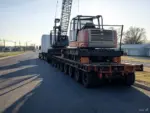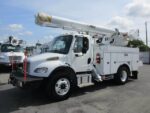


You bought a rough-terrain crane at auction, need a truck-mounted boom truck between jobsites, or are relocating a crawler with the boom and counterweight staged for the road. Knowing how to transport a crane starts with travel-position height and width, shipping weight (with or without counterweight), and whether the unit rolls under its own power. Get those right and Logi Transports can match flatbed, step deck, or RGN — without a deck that will not clear the boom or a permit surprise on load day.
Ready for a real quote? Call (864) 791-5644, email quotes@logitransports.com, or use our quote request form. Send travel-position specs and we will route the right equipment for your crane transport.
Why crane type changes the trailer
Truck-mounted boom trucks, rough-terrain (RT) cranes, all-terrain (AT) cranes, and crawler cranes share a lifting function — not a shipping envelope. A compact boom truck with the boom cradled over the cab may stay legal on a flatbed or move as a driveaway when the chassis is road-legal. An RT crane with a tall cab, retracted boom, and outriggers often needs a lower deck. A crawler with tracks, a lattice or telescopic boom section, and a heavy counterweight package can push you into step deck or RGN territory once you stack machine height on trailer deck height and add axle weight.
One non-negotiable: measure and ship in travel position. Brochure “maximum tip height” photos with the boom fully extended are not shipping dimensions. Retract and cradle the boom per the OEM travel procedure, note whether counterweight stays on or ships separately, lock outriggers and jibs, and record any exhaust, ROPS, or boom tip that sticks up. If you are comparing deck types for other iron, our guide on RGN vs step deck vs flatbed shows when each option wins for heavy equipment.

The legal envelope: height, width, and weight
Federal size and weight rules set the Interstate baseline; states fill in height and many route details. The FHWA maintains an overview of freight size and weight policy. There is no federal maximum vehicle height — states set height limits, commonly in the roughly 13′6″–14′ range on many routes, so travel-position height plus trailer deck height is what decides flatbed vs step deck vs RGN.
On the National Network, federal width for most commercial vehicles is capped at 102 inches (about 2.6 m) under 23 CFR 658.15, with limited exceptions (for example Hawaii’s higher state maximum and special-use permits). Many RT cranes advertise a compact carrier under 10 ft wide for jobsite transportability — Grove’s GRT765 product page notes a carrier under 10 ft (3 m) wide with a listed GVW of 93,345 lbs — but once you add mirrors, tiedown overhang, or a wide counterweight stack on a trailer, you can still trip oversize width. Treat manufacturer “under 10 ft” as a starting point, not a finished permit measurement.
Federal Interstate gross vehicle weight tops out at 80,000 pounds unless a state permit authorizes more, subject to axle and Bridge Formula limits in 23 CFR 658.17. A mid-size RT crane with counterweight installed can sit near or above that envelope once you add tractor and trailer tare, which is why many crane moves split counterweight or use multi-axle RGN configurations. Do not invent a permit fee from a blog — quote from measured weight and the states on your route.
Specs to send before we quote
- Make, model, and year — so we can cross-check brochure shipping weights against your actual configuration.
- Empty / shipping weight — scale ticket or plate weight; say whether counterweight, jib, and hook block are on or off.
- Height in travel position — ground to highest point (cradled boom tip, cab, exhaust, or outrigger housing).
- Width and length — widest point with mirrors and boom cradle; overall length with boom over the front or rear as configured for travel.
- Tracks or tires — crawler vs wheeled; tire size if known (affects deck loading and clearance).
- Running / steering status — drives and steers, deadlined, or needs winch-on / assist.
- Origin and destination — city/state plus any yard access limits (soft ground, low wires, gated yards).
Those items are what our brokers need before we promise a trailer type. For cost context on similar equipment moves, see heavy equipment transport cost 2026. Our broader how to prepare heavy equipment for transport Guide covers fluid, battery, and access rules that also apply to cranes. If the crane is still on a boom truck chassis that is licensed to roll, compare with what is driveaway transport before you assume a trailer is required.
Flatbed vs step deck vs RGN for cranes
| Mode | Typical deck / well (planning) | When it fits a crane |
|---|---|---|
| Flatbed | ~48–60 in deck | Compact boom trucks and shorter RT units whose travel height stays legal on a standard deck; sometimes with boom and counterweight staged carefully |
| Step deck | ~36–42 in lower deck | Taller RT or truck cranes that need a lower platform without going full RGN |
| RGN | ~18–24 in well | Heavy crawlers, tall boom packages, non-running units, or loads that need drive-on / winch-on and maximum height clearance |
Need equipment moved near you? Start with our equipment transport near me page, or go straight to dedicated crane transport if you already know the machine type. Flatbed-friendly units can also fit our flatbed transport lanes when dimensions allow, and oversize corridor planning lives on our oversize load transport page.

Prep and securement that keep the load moving
FMCSA cargo-securement rules for heavy vehicles, equipment, and machinery that weigh 10,000 lb or more are in 49 CFR 393.130. In short: accessory equipment such as hydraulic attachments must be completely lowered and secured; articulated sections must be restrained so they cannot articulate in transit; and wheeled or tracked machines need a minimum of four tiedowns that restrain lateral, forward, rearward, and vertical movement, affixed as close as practicable to the front and rear (or to designed mounting points).
- Retract and cradle the boom / jib per the OEM travel procedure; install locking pins.
- Decide whether counterweight ships on the crane or as a separate piece — and measure both configurations.
- Lower hooks, blocks, and hydraulic attachments; remove or secure loose tools and cribbing.
- Lock outriggers and beams in the travel position; tape or tag any switches the driver should not touch.
- Drain or secure fuel and hydraulic leaks; disconnect or secure batteries if the yard requires it.
- Photograph all four corners and the boom tip height with a tape in frame before the carrier arrives.
Similar prep logic shows up in our how to transport a bucket truck Guide — the crane-specific difference is almost always boom cradle height and counterweight strategy. Skip those and you risk an oversize height or a refused load.
Real-world size example (manufacturer sheet, not a quote)
Manufacturer product guides are useful planning anchors, not a substitute for your scale ticket. Grove’s GRT765 rough-terrain crane lists a GVW of 93,345 lbs and compact dimensions under 10 ft (3 m) wide on the official product page, with the matching product guide listing a standard one-piece counterweight of 15,200 lb. That combination alone explains why many RT moves either strip counterweight, use multi-axle trailers, or both — and why we ask whether the counterweight is on or off before we name a trailer. Your auction unit may differ by engine, boom length, and options, so always measure the machine in front of you.
Get a crane transport quote from Logi
Logi Transports is a Sebastian, Florida freight broker (MC-1636889, USDOT 4230991). We arrange a vetted carrier and the right trailer for your crane — we do not invent fleet sizes or guarantee a specific truck until specs and lanes are confirmed. Send make/model, travel-position height and width, shipping weight with counterweight status, and origin/destination city and state.
Call (864) 791-5644, email quotes@logitransports.com, or submit the quote request form. Tell us you are moving a crane and we will match flatbed, step deck, or RGN to the numbers you measured — not the brochure photo with the boom in the air.