

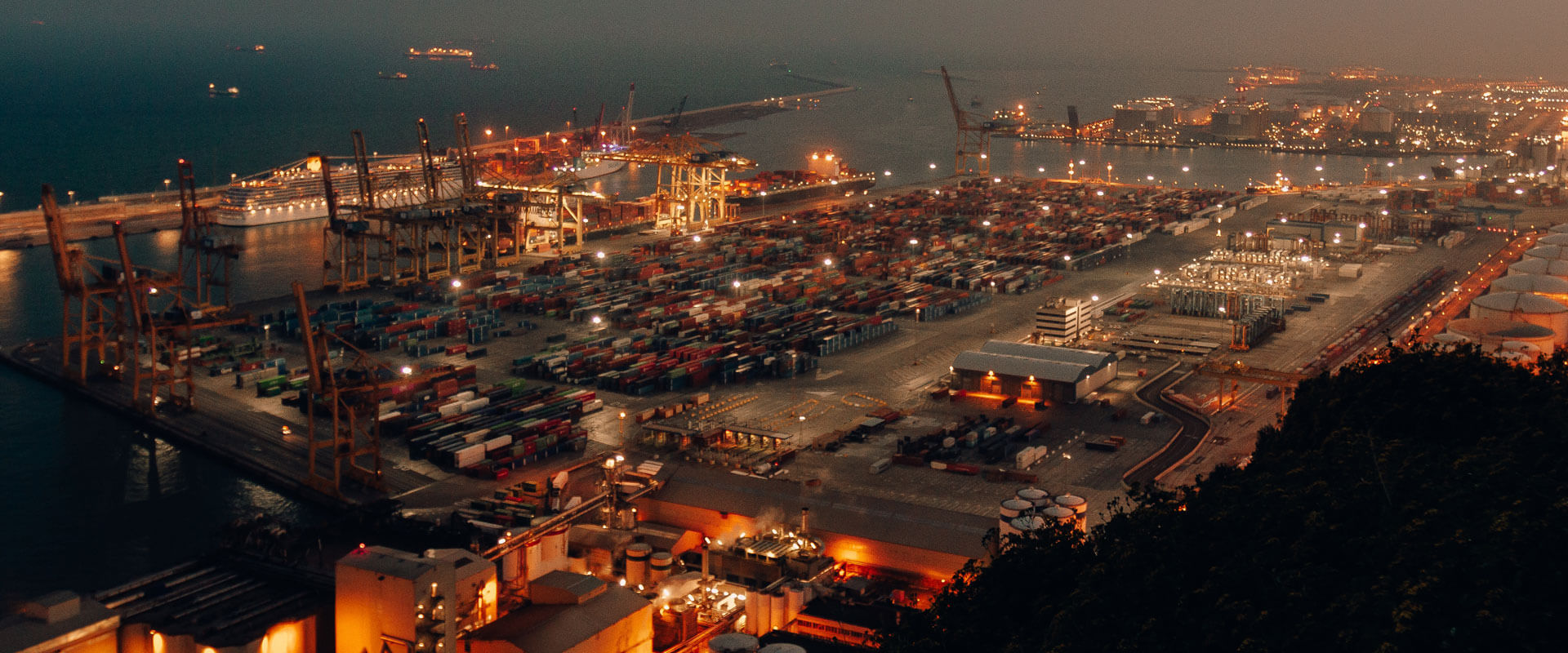
You won the Bobcat at auction. The landscaping crew needs a compact track loader by Friday. Or the dealer just texted — your skid steer is ready for pickup. However the machine landed on your calendar, the next question is the same: how to transport a skid steer without guessing a hotshot that cannot clear the bucket, eating a width permit you did not budget, or watching a driver refuse a soft pad with no ramp room.
Skid steers and compact track loaders (CTLs) are their own problem set. Arms and bucket geometry, tire vs track width, grapples and forks still on the coupler, and whether the unit runs change the trailer call faster than a brochure weight ever will. This Guide walks you through why trailer choice matters, the legal envelope, travel measurements, hotshot vs flatbed vs step deck (and when an RGN still shows up), a securement-aware prep checklist, jobsite and auction access, and exactly what to send Logi Transports for a real quote. It complements our skid steer transport service page — trailer choice and prep for a quote, not a thin rewrite of that page.
Need a deck for your skid steer? Call (864) 791-5644, email quotes@logitransports.com, or use the quote request form.
Why trailer choice matters for skid steers
A wheeled skid steer that rolls onto a hotshot gooseneck is a different job than a heavy CTL with a wide grapple still pinned and soft ground at pickup. Arms left high tip you into over-height on the first bridge. No ramp plan for a non-runner means renting a forklift you did not price. Auction yards add another wrinkle: per Ritchie Bros. loadout policies, the buyer arranges loading, self-propelled equipment is not loaded by the yard, and load-out is daylight hours only. Ritchie Bros.’ shipping guidance is clear — after the sale, transportation is on you, and cost tracks distance, size, weight, trailer type, permits, and site access.
That is why Logi starts with travel dimensions and attachments, then matches hotshot, flatbed, step deck — or rarely an RGN — not the other way around. For planning ranges (not a bid), see our 2026 heavy equipment transport cost Guide.
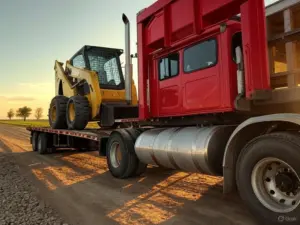
The legal envelope (FHWA + state height)
Federal rules do not pick your trailer. They set the Interstate and National Network envelope your loaded combination has to live inside — or you buy permits.
Per the FHWA commercial vehicle size and weight program and 23 CFR 658.17, Interstate maximums include:
- 80,000 pounds gross vehicle weight
- 20,000 pounds on a single axle
- 34,000 pounds on a tandem
- 102 inches of width on the National Network
There is no federal height limit. FHWA notes that state standards generally range from about 13.6 to 14.6 feet. Florida — our home base in Sebastian — caps legal height at 13 feet 6 inches inclusive of load under Florida Statute 316.515. Width on Florida public roads is also generally capped at 102 inches exclusive of certain safety devices under the same statute.
Simple math: deck height + skid steer height in travel position = total loaded height. A wide bucket, grapple, or track stance can push you over 102 inches even when height is fine. When the combination sits outside legal size or weight, you are in oversize load transport territory — we coordinate permits as part of the move rather than leaving you to memorize every state’s escort trigger.
Measure in travel position (arms down, not brochure mode)
Guessing dimensions is how a “cheap” hotshot quote becomes an over-width flatbed job on load day. Measure the skid steer or CTL as it will sit on the deck:
- Operating weight — Plate or known operating weight, including fluids and any pinned attachment. That number feeds axle loading against the federal 80,000 lb GVW ceiling and tells us hotshot vs heavier deck.
- Height — Arms and bucket (or forks) lowered into the travel position your OEM recommends. Raised lift arms are wasted height and a common reason a flatbed suddenly needs a permit.
- Width — Tire-to-tire or track-to-track, plus any bucket, grapple, broom, or side-mounted accessory left on the coupler. Wide tires and grapples are a frequent 102-inch trip-up.
- Length — Tip of bucket or forks to the rear of the machine (include rear counterweight or hitch if present). Long forks and oversized attachments often ship cleaner as a second legal piece than as one over-length combination.
- Attachments inventory — What stays on vs. what you remove: bucket, grapple, forks, auger, trencher, broom, pallet forks, quick coupler type.
Year, make, model, and serial help us confirm specs at auction yards and dealer lots. Same discipline as our general how to prepare heavy equipment for transport checklist — skid-steer twists are arms-down height, tire vs track width, and coupler attachments. Larger cousins on excavator transport share the measure-first habit; boom height usually pushes diggers up the trailer ladder.
Which deck: hotshot, flatbed, step deck, or RGN?
Deck height bands below are industry-typical planning figures, not FHWA standards. Exact decks vary by manufacturer and axle package — always measure your skid steer and confirm with the carrier. Full comparison lives in RGN vs step deck vs flatbed.
| Trailer | Typical deck height | Best for skid steers when… |
|---|---|---|
| Hotshot | Varies (often gooseneck / small deck) | Most compact wheeled or tracked units, lighter weight, shorter lanes, legal dimensions — the usual first call for Bobcat-class machines |
| Flatbed | About 48–60 inches | Heavier CTLs or multi-unit decks whose travel height stays under state limit on a ~5 ft deck; forklift or ramp load available |
| Step deck | Lower deck about 36–42 inches | Cab guard / light bar / arms too tall for a flatbed stack; you still have forklift/crane/ramp access |
| RGN / lowboy | Well about 18–24 inches | Rare for compact skid steers; use when drive-on/winch-on is required, height is tight with attachments, or you are bundling with taller iron on the same move |
Wheeled skid steers and lighter CTLs often land on hotshot when height and width stay legal. Heavier CTLs with wide pads or tall guards frequently need a flatbed or step deck. RGN is uncommon for a single compact loader — save it for drive-on sites, a still-tall arms-down stack, or when the same truck already moves excavator-class iron.
Farm iron follows similar deck logic at the compact end — see how to transport a farm tractor if you are moving both. Attachment width and whether it runs keep most skid steer jobs in the hotshot/flatbed band.
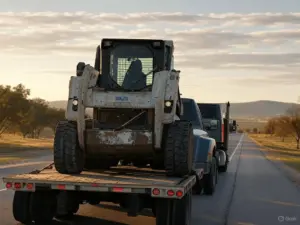
Prep checklist + cargo securement (49 CFR 393.130)
Prep protects the machine and keeps the quote honest. For wheeled or tracked equipment that weighs 10,000 lb or more, 49 CFR 393.130 requires accessory equipment completely lowered and secured, plus a minimum of four tiedowns restraining lateral, forward, rearward, and vertical movement near the front and rear (or OEM mount points). Many skid steers sit under 10,000 lb and follow §§ 393.100–393.114 — still lower the arms, lock the coupler, and expect solid chains.
- Fluids and leaks — Fix active drips. Fuel at a safe low operating level (enough to drive on if it runs, not a full tank that adds weight and spill risk). Follow the OEM transport chapter for battery disconnects and parking brake / travel lock.
- Arms / bucket / forks — Lower into travel position and pin or lock. Raised lift arms are wasted height and a securement problem.
- Remove wide accessories when it helps — Grapples, wide buckets, or side brooms can force an oversize width permit. Sometimes a second legal load beats one permitted combination — we will say which path wins after we see the numbers.
- Tires, tracks, and undercarriage — Note tread or track condition and any loose pads. Soft ground at pickup is a loading risk, not just a photo op.
- Photos — Four sides plus close-ups of existing scrapes, glass, tire/track wear, coupler, and serial plates. Walk the same set at delivery before you sign.
- Runs vs non-running — Say it in writing. Running units can often drive onto a hotshot or ramp; non-runners need winch, forklift, or crane. Undisclosed dead batteries are how pickups get refused.
At auction yards, have the release ticket and bill of lading plan ready before the driver arrives — Ritchie Bros. will not release unpaid equipment, and the yard will not load self-propelled units for you.
Site access: jobsites, mud, and auction yards
A perfect prep checklist fails if the truck cannot reach the skid steer. Before pickup and delivery, confirm:
- Gate width and swing — a gooseneck or flatbed needs more room than a pickup with a landscape trailer
- Overhead wires, low tree limbs, and scaffold on the approach
- Firm ground for loading (jobsite mud, soft sand, and steep pads stop hotshots and semis alike)
- Room to stage ramps without blocking the county road
- Load-out hours at auction yards and dealer lots (daylight-only at many auction sites)
- A contact with a cell phone who can unlock gates and move other equipment out of the way
If the machine is deep in a pad with no truck access, say so early. We may need a local float, winch plan, or staging spot on pavement. That honesty keeps skid steer shipping cost expectations real. Auction logistics tips also live on best heavy equipment auctions.
What to send for a skid steer transport quote
Send this and we will tell you hotshot, flatbed, step deck, or RGN before you pay for the wrong deck:
- Year, make, model, and whether it runs
- Operating weight and travel length / width / height (arms down, tires or tracks, attachment included)
- What stays attached vs. ships separately
- Full pickup and delivery addresses, gate width, and ground conditions
- Date flexibility (and auction lot / release status if applicable)
Ask for all-in pricing: linehaul, fuel, and any permits if the combination is oversize. A cheap base rate with permits billed later is how a simple compact-loader move gets expensive. Planning context (not your invoice) is in our cost 2026 Guide.
You the client are our top priority here at Logi Transports — we would rather talk you out of an RGN you do not need than upsell a deck that burns money.
Get your skid steer moving
CEO Benjamin C. Hall and the team at Logi Transports (Sebastian, FL freight broker MC-1636889 / USDOT 4230991) arrange legal and permitted skid steer shipping nationwide. Read more about how we work on Why Logi.
Ready to ship? Call (864) 791-5644, email quotes@logitransports.com, or submit the quote request form with your travel specs and photos. We will match hotshot, flatbed, or step deck to your skid steer and get it on the road.
We will take it from there.

Leave a Reply