
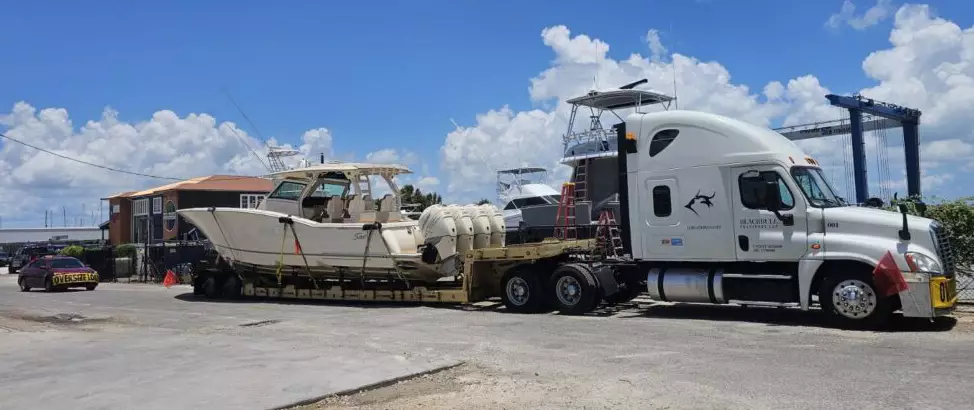
If you already own the trailer — a fifth wheel, travel trailer, boat trailer, empty flatbed, or heavy equipment trailer — you do not always need a second trailer under it. Sometimes the smartest move is simple: we send a tractor (the power unit), hitch to your trailer, and pull it.
That is power only transport.
This Guide explains what power only trucking actually is, how it differs from loading everything onto an RGN or flatbed, when driveaway is the better cousin, and what specs Logi Transports needs so your quote is real — not a teaser that blows up at the scale.
Need a pull for your trailer? Call (864) 791-5644 or use the quote request form.
What is power only transport?
Power only transport (also called power only trucking, tractor-only, hook-and-pull, or PO) is an arrangement where the carrier supplies the tractor and driver, and you (or another party) supply the trailer. The driver hooks to your staged trailer, hauls it, and drops it at delivery. The carrier does not bring a second deck to load your unit onto.
Industry explainers such as O Trucking’s 2026 power only guide and FreightWaves’ power-only overview describe the same model: shipper-owned or third-party trailers, carrier-owned power. On load boards you will see equipment type “Power Only” or “PO.”
At Logi Transports, that model is how we move a lot of real-world equipment that is already on wheels:
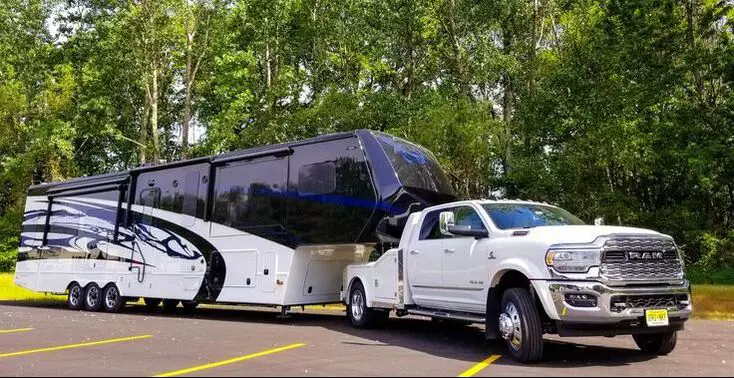
- Travel trailers and fifth wheels
- Boat trailers (and power-only boat pulls)
- Empty or loaded flatbeds, step decks, and lowboys that need repositioning
- Gooseneck and pintle-hitch equipment trailers
- Other roadworthy trailered units that cost more to crane onto a second deck than to tow
See our service pages for power only transport and power only services for how we staff these pulls.
Power only vs loading on a flatbed / RGN
People mix these up because both involve a semi. The difference is what sits under the cargo.
| Option | What we bring | What you provide | Best when… |
|---|---|---|---|
| Power only | Tractor + driver | Your trailer (already roadworthy) | The unit is already on a legal, towable trailer |
| Flatbed / step deck / RGN haul | Tractor and open-deck trailer | The machine or cargo only | No trailer of your own, or the unit must ride on a lowboy well |
| Driveaway | Driver only (or ferry driver) | A self-propelled roadworthy vehicle | The unit drives itself (motorhome, truck, etc.) |
If your excavator is sitting on the ground with no trailer, you need an open deck — usually flatbed, step deck, or RGN. That is the world covered in our RGN vs step deck vs flatbed Guide and our 2026 heavy equipment transport cost ranges.
If your fifth wheel, boat, or equipment trailer is already hitched-ready and road legal, power only is often cheaper and faster: no crane, no second deck height stack, no loading day. That is why power moves are a huge slice of this industry — and why Logi keeps dedicated power only trucking capacity on call.
The federal envelope still applies (FHWA + the states)
Hooking to your trailer does not invent a new set of size and weight rules. The loaded combination still has to live inside federal and state limits — or you buy permits.
Per the FHWA commercial vehicle size and weight program, Interstate maximums include:
- 80,000 pounds gross vehicle weight
- 20,000 pounds on a single axle
- 34,000 pounds on a tandem
- 102 inches of width on the National Network
There is no federal height limit. FHWA notes that state standards generally range from 13.6 to 14.6 feet. Florida (our home base in Sebastian) is commonly a 13 feet 6 inches legal height state. A tall fifth wheel, boat on bunks, or equipment with a high attachment can push a “simple pull” into oversize load transport territory the moment total height or width clears the legal envelope.
So measure the whole combination in travel position: tractor + your trailer + whatever is on it. Width of fenders, mirrors (mirrors are usually excluded as safety devices under federal width rules), boat swim platforms, and ROPS all matter.
Paperwork: authority, interchange, and insurance
Power only is still for-hire trucking. The carrier needs proper FMCSA registration (USDOT and, for for-hire property, operating authority / MC). Logi Transports operates as a Sebastian, Florida freight broker under MC-1636889 / USDOT 4230991 and arranges qualified carriers for these pulls.
When authorized carriers interchange equipment, federal rules expect a written arrangement. Under 49 CFR 376.31, an interchange agreement must describe the equipment, the points of interchange, how the equipment will be used, and the compensation — and it must be signed by the parties or their authorized representatives. Through bills of lading and equipment identification rules also apply in interchange service.
Practical takeaway for you as the trailer owner:
- Confirm who owns the trailer and that registration / inspection stickers are current.
- Expect the carrier to inspect tires, lights, brakes, and coupling before departure.
- Ask what non-owned trailer / cargo coverage applies while your trailer is hooked to their tractor.
- Photograph the trailer from all sides at pickup — existing scrapes should not become “new damage” later.
O Trucking’s carrier-facing guide is blunt on the same points: drivers remain responsible for a safe pre-trip even when they do not own the trailer, and non-owned trailer coverage is the usual insurance difference versus owning your own deck.
When power only is the right call
Choose a tractor pull when most of these are true:
- Your unit is already on a trailer (or is the trailer)
- The trailer is roadworthy: tires, brakes, lights, hitch, and frame are sound
- You know the hitch type — bumper pull, fifth-wheel / kingpin, gooseneck ball, or pintle (electric vs air brakes matters)
- Loaded dimensions stay legal, or you are willing to permit the overage
- Loading onto a second deck would cost more than the pull (crane, yard time, height permits)
Classic Logi use cases:
- Fifth wheel or travel trailer relocation — often cheaper to tow than to load on a flatbed. Prep checklist: our how to prepare your fifth wheel Guide.
- Boat on its own trailer — power-only boat pulls are common when the bunk trailer is solid. Prep: preparing your boat for transport.
- Empty equipment trailer repositioning — move the deck where the next machine is.
- Overflow fleet moves — you own plenty of trailers; you just need power for a lane.
When power only is the wrong call
Do not force a pull when:
- The machine is sitting on the dirt with no trailer — you need flatbed / step deck / RGN
- Tires are bald, brakes are soft, or lights are dead — that is a roadside citation waiting to happen
- The unit is a self-propelled roadworthy vehicle that should be driven, not towed — that is driveaway
- Height, width, or weight with your trailer attached forces a nightmare permit stack that a lower RGN haul would avoid
- You cannot confirm hitch type or brake system (pintle air vs electric is a common trip-up)
You the client are our top priority here at Logi Transports — we would rather talk you into an RGN you need than sell you a power-only pull that gets parked at the first weigh station.
Driveaway vs power only (quick distinction)
Driveaway is for units that drive themselves under their own power: many motorhomes, roadworthy trucks, and some equipment that is street-legal. A driver ferries the vehicle; there is no customer trailer in the middle.
Power only always involves hitching to a trailer you (or a third party) provide.
Both show up on our service menu. Tell us which you have — “it drives” vs “it needs a hitch” — and we will not quote the wrong product.
What we need for a tight power only quote
Send this and we can tell you if a pull is legal, permitted, or the wrong tool:
- Exact unit type — fifth wheel, travel trailer, boat trailer, flatbed, gooseneck, etc.
- Hitch and brake type — bumper, kingpin, gooseneck ball, pintle; electric or air
- Travel length / width / height and approximate loaded weight (operating weight of cargo + trailer)
- Whether the trailer runs (tires, lights, brakes OK) and whether anything must be removed (awnings, antennas, outboards)
- Full pickup and delivery addresses, gates, and whether a semi can get in and out
- Date flexibility
Ask for all-in pricing: linehaul, fuel, and any permits or escorts if the combination is oversize. A cheap base pull with permits billed later is how a simple relocation gets expensive.
CEO Benjamin C. Hall and the team built Logi to stop the avoidable messes — wrong hitch assumption, missing permit, nobody answering when the driver is two hours out. Read more on Why Logi.
Get your power only transport quote
Ready to move the trailer you already own? Call (864) 791-5644, email quotes@logitransports.com, or submit the quote request form with hitch type and dimensions. We will come back with a clear plan: power only pull, driveaway, or an open-deck haul if that is what the iron actually needs.
We will take it from there.